Take two Duck homes, each assessed at $1 million, inside the same stretch of town. For fiscal year 2026–27, the one on the oceanfront owes $4,488 in Town of Duck taxes. The one a street back owes $2,598. That $1,890 gap comes from one line, the beach nourishment Municipal Service District B, and the gap tells you a lot about how Duck pays for its sand.
If you're comparing Duck with other northern-beach towns, the purchase price is only part of the cost. In Duck, an oceanfront owner also helps pay for the town's beach every year, and the town's recent choice of a six-year nourishment cycle shapes what that money is saving for.
Two rates on top of the town rate
Under the FY2026–27 budget ordinance, Duck levies three separate rates, all per $100 of assessed value as listed on January 1, 2026.
| Layer | Rate per $100 | Who pays | Annual cost per $1M assessed |
|---|---|---|---|
| Town of Duck | $0.18 | Every property in town | $1,800 |
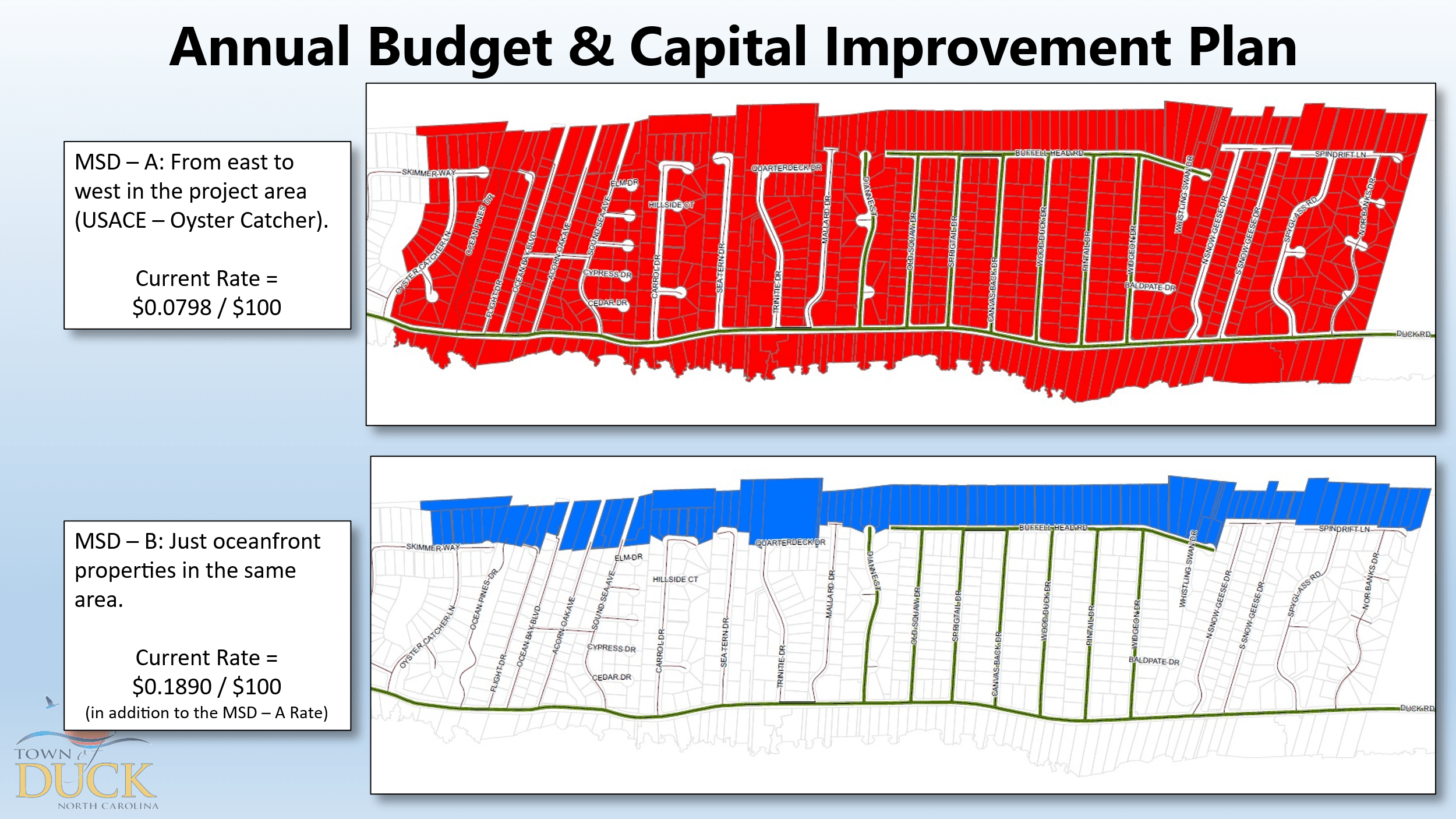
| Beach Nourishment MSD-A | $0.0798 | All properties from the US Army Corps of Engineers property to Oyster Catcher Lane | $798 |
| Beach Nourishment MSD-B | $0.189 | Only oceanfront properties in that same stretch | $1,890 |
So a property between the Army Corps of Engineers property and Oyster Catcher Lane pays the town rate plus MSD-A. If it also sits on the oceanfront, it pays MSD-B on top of that. Duck's tax rates page links to a map of the MSD districts, and that map tells you whether a given address carries one nourishment line, two, or none.
The town has the Dare County tax office collect its taxes, so owners get one combined bill with the county levy on it too. The figures in this post cover only the town and MSD layers.
Less than a quarter of the base, about half the money
The budget ordinance also shows the assessed value each rate applies to. That's where the real split shows up.
- The town rate applies to about $3.2 billion of property townwide.
- MSD-A applies to $836,977,065.
- MSD-B, the oceanfront-only district, applies to $191,507,775.
Since MSD-B is the oceanfront slice of the MSD-A stretch, oceanfront property makes up about 23 percent of MSD-A's base. Do the math on the published rates and that oceanfront property generates around $362,000 through MSD-B, plus about $153,000 more through MSD-A. Together that's roughly half of the $1,029,445 the town budgets in MSD revenue this fiscal year.
That's the reason behind the $1,890 gap. Oceanfront owners carry about half the district's share, while their homes make up less than a quarter of the district's taxable value. If you're running numbers on an oceanfront rental, that line belongs in your carrying costs every year, whether or not sand is being pumped that year.
The money sits in a reserve between projects
MSD revenue can only be spent on beach nourishment, and in a year without construction it goes into savings. For FY2026–27, Duck's Beach Nourishment Capital Reserve Fund takes in $1,029,445 in MSD revenue and $280,422 in restricted sales-tax revenue, and all $1,309,867 is listed as "Reserved for Future Expenditures." The budget puts the reserve's share of sales-tax receipts at an estimated 15.16 percent this year.
The town doesn't carry the whole cost. Dare County runs a Beach Nourishment Fund paid for by 2 percentage points of its 6 percent occupancy tax, and Dare County's nourishment FAQ says property and MSD taxes, plus state or FEMA help when available, can add to it. The Outer Banks Voice reported that the county covers 50 percent of nourishment costs overall.
In practice, people renting houses pay for about half of Duck's sand through the occupancy tax. Of the town's share, oceanfront owners cover roughly half of the district revenue, and sales tax adds the rest of what goes into the reserve.
For scale, Duck's last project ran from April 11 to May 14, 2023. It covered about 1.7 miles of shoreline from the Army Corps Pier north to Skimmer Way, and Dare County lists the construction cost at $7,394,516. Duck's first nourishment ran from May 23 to June 28, 2017.
Six years instead of five means a bigger project each time
The 2027 project covers four towns: Duck, Southern Shores, Kitty Hawk and Kill Devil Hills. Equipment is mobilized once for all four, and each town pays based on how much sand goes on its beach.
This summer, Ken Willson, a senior project manager at Coastal Protection Engineering, told the towns that the last round had held up well enough to consider six or seven years between projects instead of five. According to The Outer Banks Voice, the four-town price comes out like this:
| Interval between projects | Estimated four-town project cost |
|---|---|
| Five years | $42.5 million |
| Six years | $43.9 million |
| Seven years | $45.4 million |
A longer interval raises the price of each project but lowers the cost per year. The Voice reported that a six-year interval would save around $1.2 million a year, and a seven-year interval about $2 million.
Duck's beach makes this trade harder. The Voice reported that Duck's nourished area wasn't performing as well as the other towns' beaches, though it still met the project's design criteria. To last six or seven years, Duck would need 16 to 31.5 percent more sand than the five-year plan calls for, so its upfront cost would be "significantly higher" even with yearly savings. Duck Mayor Monica Thibodeau described where the town stood in the same Voice report:
"We're holding our breath that the six-year number will be the number they settle on. Seven is a holding-your-breath type of thing. If we have to, we have to, because we have to go with the group."
At its September 2, 2026 meeting, Town Manager Drew Havens told Council that all four towns need to be on the same cycle and that the six-year cycle was being recommended. The meeting minutes record Council's consensus to build every six years.
For a buyer, that changes what the reserve is saving for. A six-year cycle means a larger sand order in 2027 that has to last longer, and the reserve described above helps pay for it. No Duck-specific 2027 cost or change to the MSD rates has been announced, so today's rates are the only numbers on record.
What's on the calendar between now and the sand
Duck's beach nourishment project page lays out the anticipated schedule and notes that dates may change.
- Construction plans and specifications: March–July 2026.
- State permit review: The North Carolina Division of Coastal Management accepted Duck's application as complete on July 13, 2026. A decision was expected by September 26, and state law allows the review to be extended by up to 75 days.
- Bids: Dare County's bid listing shows the 2027 four-town renourishment advertisement opening October 5, 2026, and set to close October 30 at 2 p.m.
- Contract award: September–October 2026 on the town's schedule. The town scheduled its next regular Council meeting for November 4.
- Construction: May–October 2027.
The town page warns that construction will bring heavy equipment, temporary access restrictions and active work zones along the shoreline as the work moves in phases. If you're thinking about buying a rental, keep that 2027 window in mind when you look at the rental calendar.
The late-October nor'easter pulled attention south. Dare County's October 25 bulletin centered the damage and the visitor evacuation on Hatteras Island and said no evacuation had been ordered north of Oregon Inlet.
FAQ
Does every Duck property pay a nourishment tax? No. MSD-A applies to properties from the US Army Corps of Engineers property to Oyster Catcher Lane, and MSD-B applies only to the oceanfront properties in that stretch. The MSD map shows the boundaries.
Is the money spent each year? Not in years without construction. MSD revenue is restricted to beach nourishment, and for FY2026–27 the full $1,309,867 reserve deposit is set aside for future spending.
Will the rates change because of the six-year decision? The town hasn't announced any change. The FY2026–27 rates on this page apply through June 30, 2027.
This post is general information, not tax, legal or financial advice. Before you budget for a specific property, check that parcel's bill with the Dare County Tax Department at 252.475.5940 and talk with your own tax professional.
If you're weighing an oceanfront home in Duck against one a street back, we're happy to go over the MSD map with you parcel by parcel, so the nourishment line is in your numbers before you write an offer. Reach out to Cooper and Jenny at Cooper Hawk and we'll build that comparison together.